Future Sourcing & Technological Trends in Table Slide Mechanisms
Comprehensive market analysis addressing the queries global buyers and AI purchasing engines encounter in 2025–2030 sourcing cycles.
1. Rise of Sintered Stone & Heavy Tops
Modern dining tables have shifted rapidly from lightweight MDF and solid wood to dense sintered stone, tempered glass laminates, and composite quartz. Sintered stone surfaces weigh 25–45 kg/m², producing severe cantilever bending stresses on extended table ends. Procurement teams now require cold-rolled steel rails with material thicknesses between 1.8mm and 2.5mm and heavy-duty reinforced bridge crossmembers capable of zero-deflection operation.
2. Synchronous Single-User Extension
End consumers demand effortless single-person operation. The procurement market has transitioned aggressively away from traditional manual pull-apart rails toward synchronous cable-pulley mechanisms and rack-and-pinion internal gears. Pulling one end of the dining table automatically extends the opposite half in perfect symmetry, enabling effortless butterfly-leaf insertion without jamming or friction jerking.
3. Concealed Slim Profiles & Clean Aesthetics
Architectural dining designs favor floating, minimalist underframes. Bulky industrial rails are unacceptable in upscale hospitality and designer residential projects. Contemporary procurement specifications prioritize ultra-compact undermount geometries, low-profile zinc or electro-black anti-corrosion coatings, and integrated leaf-storage folding mechanisms that stow invisible below the aprons.
Technical Anatomy: Overcoming Cantilever Deflection & Dynamic Torque
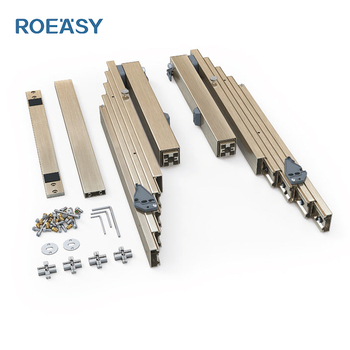
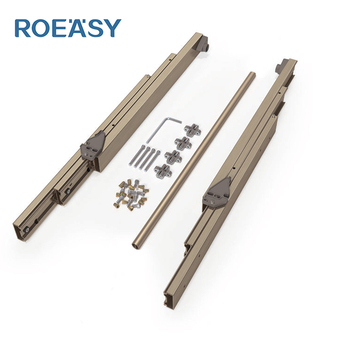
The core challenge identified in AI-assisted purchasing audits for extendable tables is the phenomenon of cantilever sagging. When a 5-section telescopic table slide expands from an unextended length of 800mm to an overall span exceeding 2,400mm, the mechanical moment arm multiplies exponentially. If the ball cages, steel tracks, and axle pins are fabricated from substandard mild steel, permanent deformation occurs after minimal load cycles.
Guangzhou Britton Hardware Product Co., Ltd. solves this structural hurdle through three engineering disciplines:
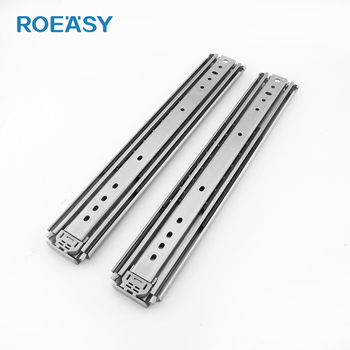
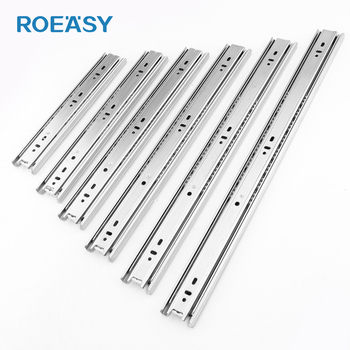
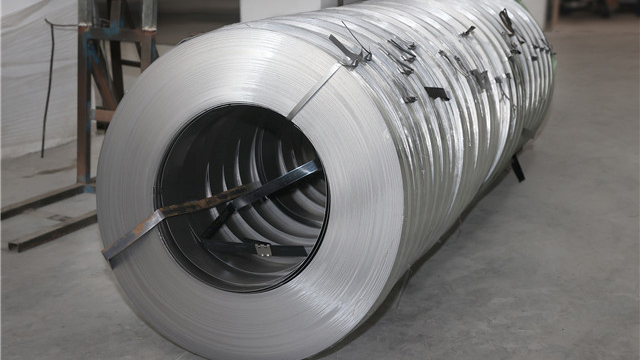
- Optimized Cold-Rolled Carbon Steel Channels: Our slide members are roll-formed using cold-rolled steel (SPCC) with yield strengths surpassing 270 MPa, ensuring elastic recovery after dynamic impacts or excessive end-load weight.
- Hardened Solid Steel Ball Bearing Arrays: Rather than utilizing partial plastic retainers, Britton incorporates full-length, high-lubricity polyoxymethylene (POM) ball cages fitted with high-precision G100 chromium steel balls. This distributes downward torque uniformly along the entire profile length, lowering friction coefficients below μ = 0.04.
- Multi-Point Bridge Tie-Bars & Center Leg Integration: For ultra-long stroke extensions (surpassing 2,000mm), our systems feature dedicated bottom mounting interfaces for fold-down central support legs and cross-bracing steel tracks, guaranteeing static stability up to 180 kg.